Sample assessment results and how to interpret them.
How to read organization, individual and matching results, and what to explore next.
Source: KIBI, MindMatch Assessment Results Guide, September 2026 edition. The supplied guide identifies the screens as data for a sample company. Actual results vary with responses.
01 Review the organization’s current situation.
Start with the overall indicators, then review the 15 factor scores and four category averages. Identify strengths and areas to explore rather than reaching a conclusion from the overall score alone.
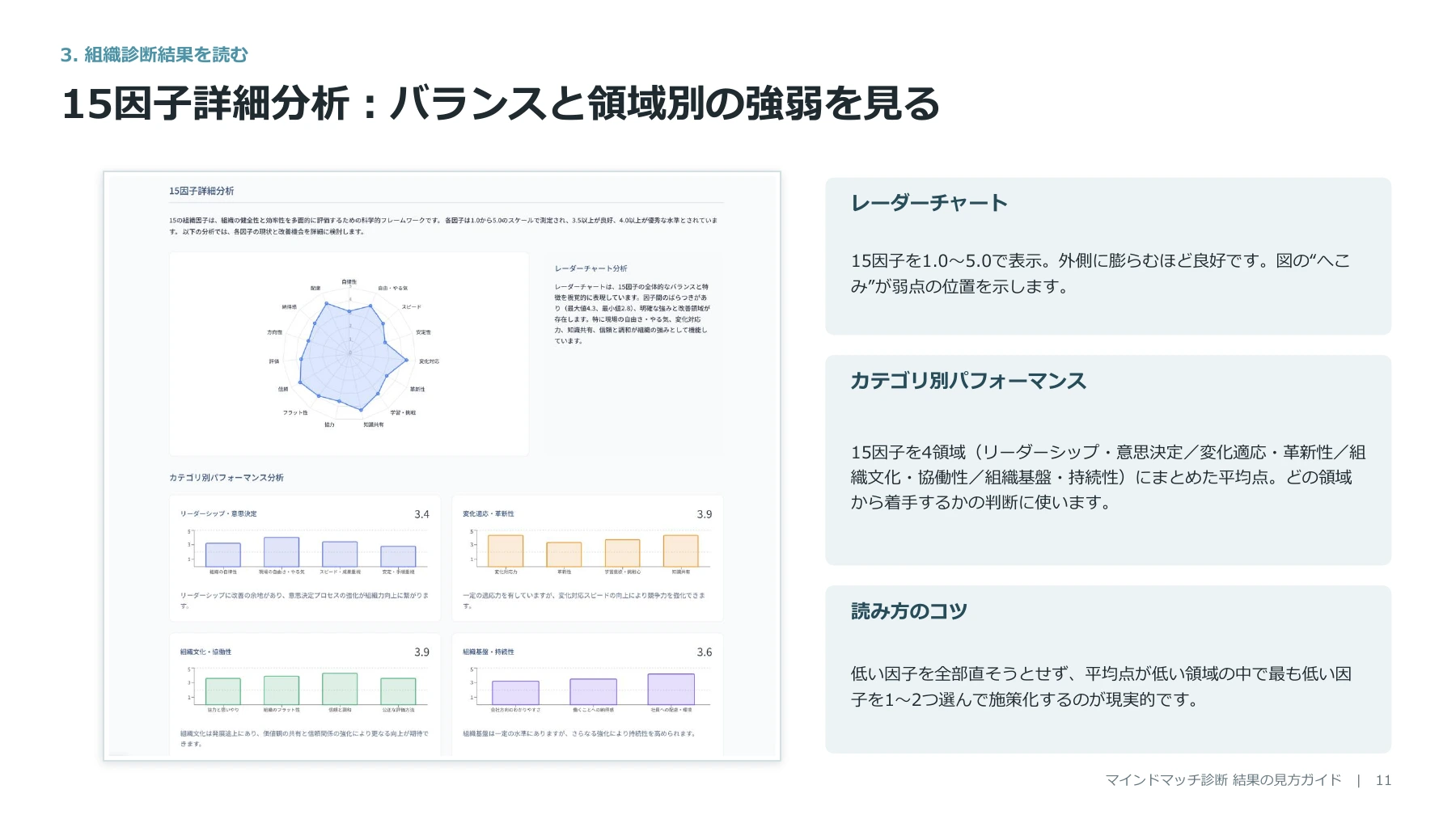
The radar chart displays scores from 1.0 to 5.0. The four categories cover leadership and decision-making, adaptation and innovation, culture and collaboration, and organizational foundations and sustainability. The guide suggests selecting one or two factors in a lower-scoring category to explore at work.
The sample screen is from the original Japanese guide. Refer to the explanations on this page for interpretation.
02 Understand individual characteristics.
An individual report describes the type, strengths, considerations and supportive or difficult environments. Read considerations together with strengths, and explore the person’s experience rather than treating them as faults.
03 Explore individual–organization matching.
Matching results show compatibility, retention potential and contribution potential, plus an overall score. A low score does not indicate low ability. Use it to discuss the relationship with the current organization and adjustable conditions such as assignments and consultation practices.
These scores do not guarantee actual retention or performance. Use them alongside interviews, conversations and working conditions, rather than as the sole basis for evaluation, hiring or placement.
04 Plan a practical next step.
One editorial application is to document decisions the employee can make and those requiring a manager’s approval, then review them at the next check-in. Adapt recommendations in the report to your own work and issues rather than applying them unchanged.
When reassessing, also review changes in respondent counts and participating departments. Changes in scores alone do not establish a measure’s effects or causes.
Once you understand the results, plan their use.
KIBI’s ongoing support and consulting can help deepen understanding and explore application and adoption across your organization.
Discuss application and ongoing supportRead how to start the first conversationRestrict access to administrative screens containing individual results to people who need it for their work. Provide feedback to the individual and explain how results will be used.
Turn your organization’s questions into a starting point for conversation.
From mutual understanding before hiring to conversations after joining.
Explore how Mind Match could be used in your organization.